
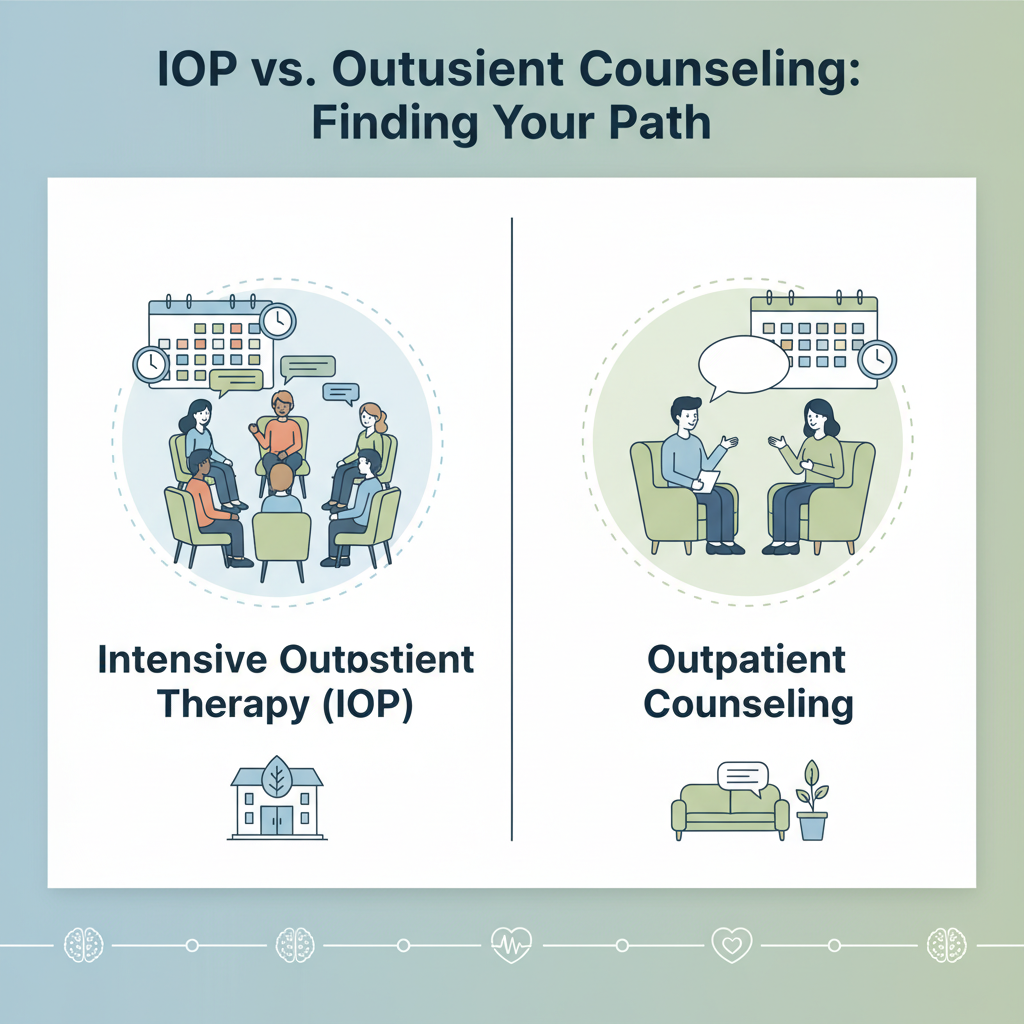
Understanding the difference between IOP and outpatient counseling
When you look for flexible treatment options, it helps to clearly understand the difference between IOP and outpatient counseling. Both provide care while you live at home, but they offer very different levels of structure, intensity, and support. Knowing how they compare can help you choose a path that fits your schedule, your symptoms, and your insurance, including Medicaid.
At its core, outpatient counseling usually means 1 to 2 therapy sessions per week, often 45 to 60 minutes each, focused on gradual change and real world coping skills. Intensive Outpatient Programs, or IOPs, involve multiple sessions per week that each last 2 to 3 hours, often totaling at least 9 to 12 hours weekly or more, with a blend of group, individual, and sometimes psychiatric care [1]. You can think of IOP as a middle step between weekly therapy and inpatient or residential treatment.
How IOP and outpatient counseling are structured
Time commitment and weekly schedule
The most noticeable difference between IOP and outpatient counseling is the time commitment. That schedule shapes how treatment will fit with work, school, childcare, and other responsibilities.
Typical outpatient counseling:
You usually meet with a therapist once a week, sometimes twice, for 45 to 60 minutes per session. In some cases, you may step down to biweekly or monthly sessions as you stabilize [2]. This model offers a high degree of flexibility and is often easier to fit around a full time work schedule.
Typical Intensive Outpatient Program:
IOP usually involves:
- 2 to 5 days per week
- 2 to 3 hours per day
- At least 9 hours of care per week, and often 12 to 20 plus hours depending on the program and your needs [3]
Many programs schedule IOP in blocks such as late afternoon or evening so you can still work or go to school. Some offer morning tracks for those with different schedules [4].
If you are trying to compare outpatient therapy with a structured addiction track, it can also help to understand how an intensive outpatient program for addiction is typically organized.
Length of treatment
Outpatient counseling can be short term or long term. You might engage in a focused course of therapy for a few months, or continue in ongoing counseling for a year or more depending on your goals and progress [5].
In contrast, IOPs are usually time limited. Common ranges include:
- 4 to 6 weeks for some mental health IOPs
- 4 to 12 weeks for addiction focused IOPs
- 30 to 90 days in many substance use programs [6]
You may then step down to weekly outpatient counseling or less intensive group support.
Session types and daily structure
In standard outpatient counseling, your primary contact is usually a one to one therapist. You might also attend occasional group sessions or see a psychiatrist separately if you need medication management.
IOPs are more structured and comprehensive. A typical IOP schedule might include:
- Therapist led group therapy several times per week
- Individual counseling sessions at set intervals
- Family sessions when appropriate
- Psychoeducation on addiction, mental health or relapse prevention
- Skills building work on coping, communication, and emotion regulation
- Medication management or psychiatric visits integrated into the program in some settings [7]
Some IOPs also offer expressive arts, yoga, or other holistic services alongside core clinical treatment [8].
If you are curious about what a typical IOP day actually looks like, you might explore what is an intensive outpatient program and intensive outpatient group therapy explained.
Level of care and clinical intensity
Symptom severity and risk level
The difference between IOP and outpatient counseling becomes especially clear when you look at who each is designed to help.
Outpatient counseling is best suited for you if:
- Your symptoms are mild to moderate
- You can stay safe between weekly sessions
- You are generally functioning at work, in school, and at home
- You have a reasonably stable support system [9]
Intensive Outpatient Programs are designed for you if:
- Your symptoms are moderate to severe, but do not require 24 hour supervision
- Weekly therapy has not been enough to stabilize you
- You are at risk of hospitalization, or are stepping down from inpatient or a Partial Hospitalization Program
- You need more structured support to prevent relapse or crisis [10]
Medicare specifically defines IOP as at least 9 hours per week of therapeutic services under a treatment plan, often used when your needs are greater than weekly counseling but you do not require an inpatient level of care [11].
Monitoring and outcome based care
In outpatient counseling, your therapist tracks your progress session by session. Some providers use standardized questionnaires, but that is less universal.
IOPs often rely on outcome based care that includes:
- Regular use of tools such as the PHQ 9 for depression and GAD 7 for anxiety
- Frequent check ins on cravings, urges, and mood
- Team based reviews that allow the treatment plan to be updated quickly as your needs change [12]
This higher level of monitoring can help your team catch setbacks earlier and adjust treatment to support you.
Services included in IOP vs outpatient counseling
Core therapy modalities
Both IOP and standard outpatient counseling use evidence based therapies such as:
- Cognitive behavioral therapy to identify and change unhelpful thoughts and behaviors
- Motivational interviewing to strengthen your own reasons for change
- Relapse prevention planning and skills
The difference is how often you use these tools and in what setting.
In outpatient counseling, you typically work on these approaches one on one in a private office or telehealth setting.
In IOP, you practice them repeatedly in:
- Group discussions where you hear how others apply similar skills
- Role plays and experiential exercises
- Homework between multiple weekly sessions
That repetition can help you internalize skills more quickly, which is especially important if you are early in recovery or facing frequent triggers.
Group and family involvement
Standard outpatient counseling can absolutely include group therapy and family sessions, but many people only ever see an individual counselor.
In contrast, group work is at the heart of most IOPs. You spend several hours per week in small therapist led groups where you:
- Share experiences and learn from others
- Practice communication in real time
- Build accountability and mutual support
Some programs make structured family sessions part of your weekly or biweekly routine, which can be key if loved ones are part of your support system or if relationships have been strained by substance use.
If you want to understand how group work fits in a broader recovery plan, you can also explore group therapy for addiction recovery.
Medication and medical coordination
In traditional outpatient counseling, medication management is often handled outside of therapy by a separate psychiatrist, primary care doctor, or clinic.
IOPs frequently integrate medication management into the program itself. Depending on the setting, you may:
- Meet with a psychiatrist as part of your IOP schedule
- Have your medications reviewed and adjusted based on your progress in therapy
- Receive education about how medications support your recovery [13]
This level of coordination can be especially important if you have co occurring mental health conditions alongside substance use.
When IOP is recommended instead of standard counseling
You might be unsure whether you truly need an intensive program. Looking at common use cases can help you and your provider decide.
Situations where an IOP is often recommended include:
- You recently completed detox, inpatient rehab, or a Partial Hospitalization Program and need a structured step down so you do not lose progress [14]
- You have relapsed more than once while in weekly counseling
- Your cravings, urges, or symptoms spike when you are alone for extended periods
- Your home environment is stressful, chaotic, or filled with triggers, and you need more time in a recovery focused setting
- You need more accountability and support to stay sober or manage symptoms between visits [15]
If your symptoms are milder, or you are further along in your recovery and mostly want maintenance support, outpatient counseling or an outpatient addiction treatment with medicaid approach might be a better fit.
When outpatient counseling is enough
Outpatient counseling can be very effective when your situation matches what it is designed to address. You might choose or remain in outpatient counseling if:
- You are generally stable, with no immediate safety concerns
- You can use coping skills between sessions without intensive supervision
- You have work, school, or caregiving responsibilities that make IOP impractical
- You have a strong recovery network, such as support groups, faith communities, or supportive family
In these cases, you may combine weekly therapy with peer support meetings or other community resources. You might also add short term increases in session frequency during times of extra stress.
If you are exploring coverage for weekly therapy, you can review medicaid coverage for counseling sessions or focus more specifically on counseling for substance abuse covered by medicaid.
Comparing benefits and outcomes for IOP vs counseling
One way to look at the difference between IOP and outpatient counseling is to ask what each is best at helping you accomplish.
Outpatient counseling can help you:
- Build insight into your patterns and triggers
- Learn and refine coping skills over time
- Maintain progress after more intensive treatment
- Address underlying issues such as trauma, anxiety, or depression at a steady pace
IOP can help you:
- Stabilize more quickly when symptoms are severe
- Reduce immediate risk of relapse or hospitalization
- Practice new skills intensively and repeatedly
- Build a strong peer network through group therapy
- Transition safely from inpatient or detox to living at home
Outcomes also depend on fit and timing. For example, if you need IOP level care but only attend weekly counseling, you may be more likely to relapse or require hospitalization. On the other hand, if you enter IOP when you truly need that structure, you may then be able to step down to standard outpatient counseling and benefit from continued support.
If you want to understand how outpatient care performs over time, it can be helpful to review data and real world experiences around outpatient counseling success rates.
How Medicaid may cover IOP and outpatient counseling
Because the article focuses on individuals and families using Medicaid, it is important to look at how coverage often works. Specific benefits depend on your state and your plan, but there are some general patterns.
Medicare Part B, which serves older adults and some people with disabilities, specifically covers intensive outpatient program services after the deductible, with you responsible for 20 percent of the approved amount [11]. Medicaid is a different program, but this federal definition of IOP is one reason many state Medicaid plans recognize and cover intensive outpatient services.
In general, Medicaid often covers:
- Standard outpatient counseling sessions for mental health and substance use disorders
- Some level of intensive outpatient or structured outpatient addiction treatment
- Medication management and related behavioral health services
You can look more specifically at does medicaid cover outpatient rehab and outpatient rehab that accepts medicaid insurance to understand how certain programs work with your coverage.
If you are focused on substance use care, resources like addiction therapy options for medicaid patients and benefits of outpatient drug rehab can help you compare levels of care and benefits.
Choosing the level of care that fits your life
When you decide between IOP and outpatient counseling, you are really balancing three things: safety, intensity of need, and practicality.
Ask yourself:
- How often do you feel like you are barely holding on between sessions?
- Have you recently relapsed or come close, even while in therapy?
- Would a more structured daily or weekly schedule help you stay on track?
- Can you realistically commit 9 to 12 or more hours per week to treatment right now?
- What transportation, childcare, and work or school factors do you need to consider?
If your answers point to needing more support but you cannot pause your life for inpatient care, an intensive outpatient program for addiction or another mental health IOP track may be the right middle ground. You can also weigh IOP alongside residential care by reviewing iop vs inpatient treatment for addiction.
If you are not sure you can handle the time commitment, it can help to clarify how long is an intensive outpatient program and look at your schedule with a counselor or case manager.
For some, especially if your symptoms are milder or you are further along in recovery, consistent outpatient therapy, possibly combined with outpatient therapy for opioid addiction or similar services, will be enough.
Next steps to move forward
Understanding the difference between IOP and outpatient counseling gives you a starting point. The next step is to talk with a provider who can assess your specific situation, including:
- Mental health and substance use history
- Current symptoms and risk level
- Home environment and supports
- Work, school, and family responsibilities
- Medicaid or other insurance coverage
From there, you can build a plan that may include a period of intensive outpatient care followed by a gradual step down to ongoing counseling, or begin directly with weekly sessions and add intensity if needed.
Whatever level of care you choose, the most important part is that you stay engaged long enough to build skills, stabilize your life, and feel more confident managing your recovery day to day.
References
- (Transitions Counseling, Medicare)
- (Verywell Mind)
- (Medicare, Meadows Outpatient)
- (With Behavioral Health)
- (Penn Highlands Healthcare)
- (Transitions Counseling, Living Room NJ)
- (Medicare, Greater Boston Behavioral Health)
- (Meadows Outpatient)
- (Verywell Mind, Penn Highlands Healthcare)
- (Transitions Counseling, Verywell Mind)
- (Medicare)
- (Transitions Counseling)
- (Greater Boston Behavioral Health)
- (Transitions Counseling, Greater Boston Behavioral Health)
- (Living Room NJ, With Behavioral Health)